
What Vintage Shaving Mugs Were Designed For, and Never Had to Be
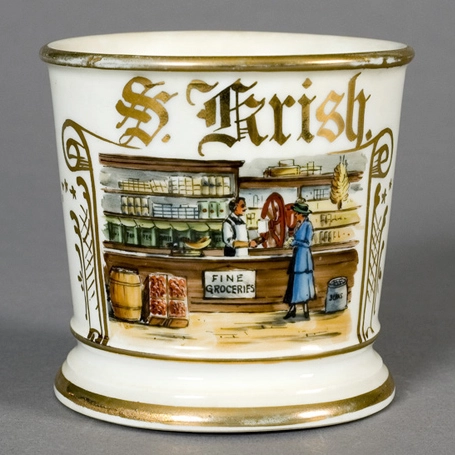
In an antique shop, it’s hard not to pause when you come across a vintage porcelain shaving mug on a shelf. Many of these vintage shaving mugs were not merely functional. They carried names in gold script, ornate borders, and small vignettes tied to a trade or profession. A locomotive for a rail man. A ship for a sailor. Tools, emblems, uniforms, and other markers of work. Each one saying, “This belonged to someone.”
These are often called occupational shaving mugs, and they were once common enough that barbers expected customers to recognize them and, in most cases, to have their own. In barbershops and homes alike, the shaving mug was a familiar vessel, designed to support a daily routine rather than stand apart from it.
Brousseau & Dov exists, in part, because those mugs still have something to show us. Not because they should be copied, but because they reveal how closely tools once followed use. They also reveal something else: the limits of a form that was sufficient for how shaving was practiced at the time.
What the Mugs Were Designed For
The mug was personal.
Occupational shaving mugs were specific by design. Names, professions, and symbols turned an everyday possession into something personal. This personalization mattered. It connected a private routine to a public identity, even when the shave itself happened at home or in a familiar barbershop.
The routine had weight.
Shaving with soap and brush required attention. Lather had to be built, not dispensed. The mug played its part in that rhythm, holding water and soap, anchoring the preparation. Even a quick shave contained a moment of intention
The tool belonged in plain sight.
Historical photographs of barbershops often show rows of mugs stored openly. At home, mugs lived on sinks or shelves. They were not hidden away. Their visibility reflected their usefulness. When a shaving item matters to a routine, it naturally earns its place.
What They Never Had to Be
It is tempting to judge older tools by modern expectations, but that misses the point. The shaving mug was not a failed bowl. It was a sufficient answer to the way shaving was practiced at the time.
Geometry followed familiarity.
Mugs were easy to hold, easy to store, and recognizable. Their narrow shape made sense when brushes were smaller, soaps were often stored inside the mug, and much of the lathering was finished on the face. When the face itself remained the place where lather took shape, there was little incentive to rethink the vessel, because shaving itself had not yet changed.
Decoration grew within the form, not beyond it.
As porcelain techniques improved, mugs became more ornate. In many cases, the artwork took center stage. This was not a mistake so much as a reflection of what the mug represented. It was a personal possession, and the decoration helped express that sense of ownership. Performance, while important, was not the primary variable being optimized.
The system depended on its moment.
Occupational mugs thrived in a world where barbershops were central, tools could be stored on site, and shaving followed an established practice supported by the trade itself. When manufactured creams and later cartridge systems reduced the need to build lather, the mug quietly stepped aside. Not because it failed, but because the practice it supported had shifted.
What we chose to carry forward
Brousseau & Dov is inspired by these porcelain mugs, but not bound by them. We treated them as a conversation partner, not a template.
We carried forward the idea that a shaving vessel can be personal, visible, and worth keeping. We embraced imagery that feels rooted in the late nineteenth century, but interpreted through a contemporary hand. We wanted artwork that felt intentional without overwhelming the object it lives on.
At the same time, we allowed ourselves to solve problems the mug was never asked to address.
We chose a bowl because modern lathering benefits from freedom of brush movement and controlled hydration. We paid close attention to geometry, interior features, and how the bowl behaves in the hand. We translated hand-drawn artwork into ceramic transfers so the character of the illustration could survive firing, curvature, and daily use without sacrificing durability or permanence.
None of this is a correction of the past. It is a continuation of its logic, applied to a different moment.
Final Thought
The most useful lesson of the nineteenth-century shaving mug is not aesthetic. It’s philosophical. Tools once followed use closely, and beauty emerged from that relationship rather than competing with it.
If a Brousseau & Dov bowl feels familiar, even the first time it is used, that is intentional. It reflects an effort to honor what earlier makers understood while acknowledging what time has changed.
The goal was never to improve on history. It was to listen to it carefully, then respond in kind.